
Quantum_harmonic_oscillator
The quantum harmonic oscillator is the quantum-mechanical analog of the classical harmonic oscillator. Because an arbitrary potential can usually be approximated as a harmonic potential at the vicinity of a stable equilibrium point, it is one of the most important model systems in quantum mechanics. Furthermore, it is one of the few quantum-mechanical systems for which an exact, analytical solution is known.
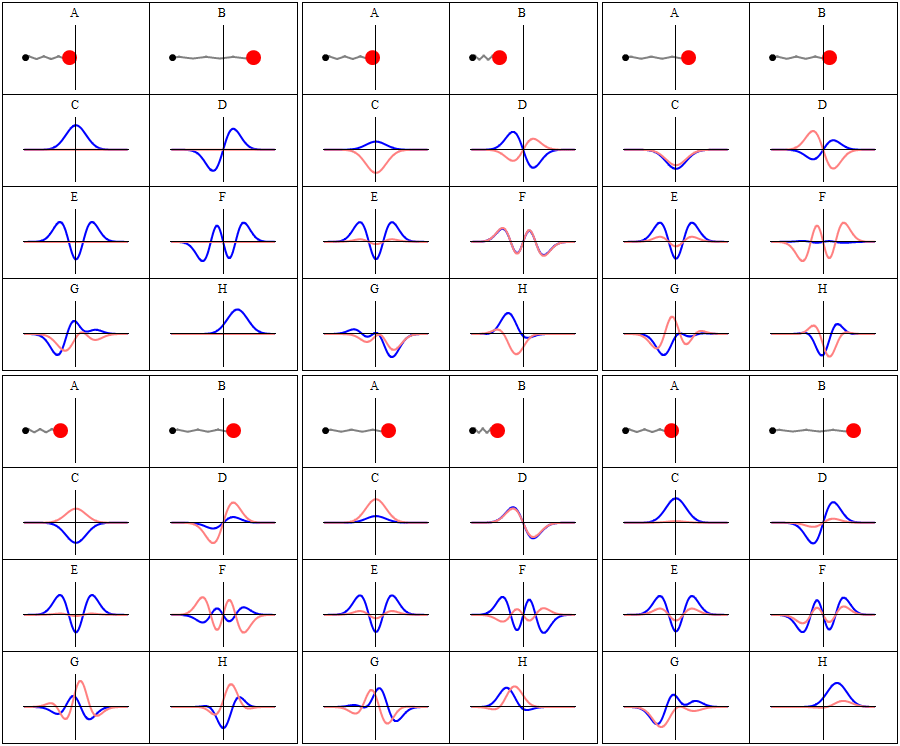
Some trajectories of a harmonic oscillator according to Newton's laws of classical mechanics (A-B), and according to the Schrödinger equation of quantum mechanics (C-H). In A-B, the particle (represented as a ball attached to a spring) oscillates back and forth. In C-H, some solutions to the Schrödinger Equation are shown, where the horizontal axis is position, and the vertical axis is the real part (blue) or imaginary part (red) of the wavefunction. C,D,E,F, but not G,H, are energy eigenstates. H is a coherent state--a quantum state which approximates the classical trajectory.
Calculation and graphing of Quantum harmonic oscillations are made easier here.
量子谐振子能级计算器
把一个粒子放在抛物线形势阱里,它的能量不能连续取,只能停在一串等间距的能级上,这就是量子谐振子。它是分子振动、晶格声子、光学腔模的共同模型,几乎所有量子力学的入门题都从它开始。这个页面按量子数 n 生成波函数与能级的数值表,用来观察 n 增大时波函数节点数怎么变、能级间隔有多均匀。
使用方法
- 「Quantum Number (n)」填要看的最大量子数,从 0 开始,n = 0 是基态。
- 「Initial value」填自变量 x 的起始值,一般用无量纲坐标,取 −4 到 4 覆盖主要波形。
- 「Increment」填 x 的步长,取 0.1 或 0.2,步长越小表格越密。
- 「Repetition」填重复次数,决定表格生成多少行;点计算后逐行读出 x 与 ψn(x) 的值。
- 要画图,把表格两列复制到绘图软件里即可,横轴是 x,纵轴是波函数值。
计算公式
| 能级 | En = (n + 1/2) × h × ν n 为量子数,h 为普朗克常数,ν 为振子频率 |
|---|---|
| 角频率形式 | En = (n + 1/2) × ħ × ω ħ = h ÷ 2π,ω = 2πν,两式等价 |
| 零点能 | E0 = h × ν ÷ 2 n = 0 时仍有能量,是测不准关系的直接结果 |
| 相邻能级差 | ΔE = h × ν 能级等间距,与 n 无关,这是谐振子的标志性特征 |
计算示例
- E0 = 0.5 × 6.626e-34 × 1e13
- E0 = 3.313e-21 J
- 换成电子伏:3.313e-21 ÷ 1.602e-19 = 0.0207 eV
- E3 = (3 + 0.5) × 6.626e-34 × 1e13 = 3.5 × 6.626e-21
- E3 = 2.319e-20 J = 0.1448 eV
要点与常见误区
- n 从 0 开始,不是从 1 开始。填 1 得到的是第一激发态,基态要填 0,这一步错了整张表都会错位。
- 能级间隔恒为 hν,与 n 无关;这是谐振子与氢原子(能级间隔随 n 变小)最本质的区别。
- 波函数有 n 个节点(不含无穷远处),n 越大振荡越快,表格步长也要相应减小才能看清。
- 普朗克常数用 6.626e-34 J·s,频率用 Hz 而不是角频率;混用 ω 会让结果差 2π 倍。
- 这里的 x 通常是无量纲坐标(实际长度除以振子特征长度),不是米,代入前先确认坐标约定。
常见问题
- 零点能为什么不为零?
- 如果粒子完全静止在势阱底部,位置和动量都确定,违反测不准关系。所以最低能态仍保留 hν/2 的能量,这部分能量无法通过降温取走。
- 量子谐振子和经典谐振子有什么区别?
- 经典振子能量连续、可以静止在底部;量子振子能量分立的等间距能级,最低态也有零点能,且概率分布在小 n 时与经典分布完全不同。
- 这个模型能用在哪些实际系统上?
- 分子振动光谱、晶格声子、电磁场模式、纳米机械振子都用它描述。只要势能在平衡点附近可近似为抛物线,就能套这个模型。