
Doppler Effect Wavelength Front Calculator
The Doppler effect (or Doppler shift), named after the Austrian physicist Christian Doppler, who proposed it in 1842 in Prague, is the change in frequency of a wave (or other periodic event) for an observer moving relative to its source. It is commonly heard when a vehicle sounding a siren or horn approaches, passes, and recedes from an observer. Compared to the emitted frequency, the received frequency is higher during the approach, identical at the instant of passing by, and lower during the recession.
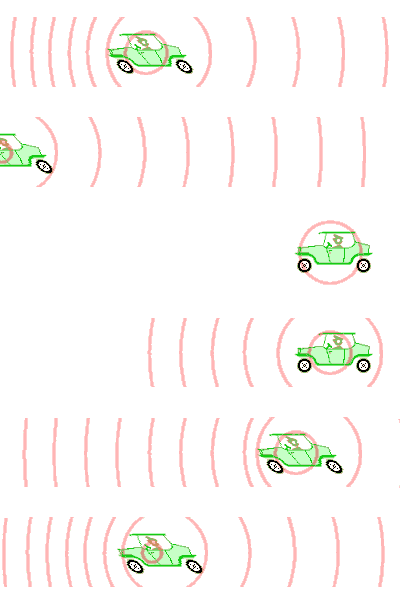
An animation illustrating how the Doppler effect causes a car engine or siren to sound higher in pitch when it is approaching than when it is receding. The pink circles are sound waves. When the car is moving to the left, each successive wave is emitted from a position further to the left than the previous wave. So for an observer in front (left) of the car, each wave takes slightly less time to reach him than the previous wave. The waves "bunch together", so the time between arrival of successive wavefronts is reduced, giving them a higher frequency. The waves "stretch apart", so the time between the arrival of successive wave-fronts is increased slightly, giving them a lower frequency.
Doppler Effect Wavelength Front:
Wavelength in Front of a Moving Source:
λf=(v-us) / f0
where,
λf = Wavelength in Front of a Moving Source
v = Wave Velocity
us = Source Velocity
f0 = Source Frequency.
多普勒效应:声源前方波长
运动声源前方的波前是挤在一起的,这就是为什么迎面驶来的车声音更尖。这个页面算的是前方相邻波峰之间的实际距离:给出波速、声源速度和源频率,得到压缩后的波长。做声源指向性分析、估算马赫锥半角、解释前方声压升高时,这个波长是起点。
使用方法
- 在「I want to calculate」下拉里选「Wavelength in Front of a Moving Source」。
- 「Wave Velocity」填波速 v,单位 m/s,空气取 340 到 343。
- 「Source Velocity」填声源速度 us,单位 m/s,朝观察者方向运动时该侧即为前方。
- 「Source Frequency」填源频率 f0,单位 Hz。
- 点计算,结果 λf 单位 m,一定小于静止波长 v ÷ f0。
计算公式
| 前方波长 | λf = (v − us) ÷ f0 声源朝该侧运动,波前被压缩,波长变短 |
|---|---|
| 静止波长 | λ0 = v ÷ f0 us = 0 时前后波长都等于它 |
| 与后方波长的关系 | λf + λb = 2 × v ÷ f0 前方压缩量与后方拉伸量相等 |
| 马赫锥半角 | sinθ = v ÷ us us 超过 v 时波前叠成锥面,θ 为锥半角 |
计算示例
- 静止波长 λ0 = 340 ÷ 500 = 0.68 m
- λf = (340 − 30) ÷ 500 = 310 ÷ 500
- λf = (340 − 170) ÷ 500 = 170 ÷ 500
要点与常见误区
- 前方用减、后方用加,符号写反会把压缩算成拉伸,整个声场图像就颠倒了。
- us 必须小于 v 才适用这个线性式子。等于 v 时波前全部叠在一起形成激波;大于 v 时用马赫锥公式 sinθ = v/us。
- 波长变短不等于频率升高,站在前方的观察者听到的频率由 (v) ÷ λf 决定,两者要一起看。
- 公式中的速度是相对介质的速度。有风时声源相对空气的速度与相对地面不同,顺风逆风会让波长差几厘米。
- 空气中声速随温度变化约每度 0.6 m/s,冬季与夏季同一辆车的前方波长能差 2%。
常见问题
- 为什么前方波长会变短?
- 声源边前进边发声,后一个波在更靠近观察者的位置产生,两个波峰之间的实际距离被压缩,波长就变短,听起来频率更高。
- 声源速度等于声速时会发生什么?
- 所有波前在同一位置叠加,形成激波面,公式分母趋零、波长趋零,声压突跳。这就是超音速飞机的音爆。
- 这个公式适用于光吗?
- 不直接适用。光没有介质,不能简单用 (c − us) 表示,需要洛伦兹变换得到相对论多普勒公式,低速时才退化成相似形式。
相关计算器
- Magnetic susceptab
- 流量计算器
- Milling Speed and
- 凹面镜焦距计算器
- 转动惯量计算器
- 力矩计算器
- 动量定理计算器(力 时间)
- 动量定理计算器(质量速度)
- 牛顿万有引力定律计算器
- 牛顿第二运动定律计算器