更多分类: 数理统计计算器 化学计算器 体积计算器

泊松分布计算器

结果:

泊松分布是一种统计与概率学里常见到的离散概率分布,由法国数学家西莫恩·德尼·泊松(Siméon-Denis Poisson)在1838年时发表。

概率论中常用的一种离散型概率分布。若随机变量 X 只取非负整数值,取k值的概率为
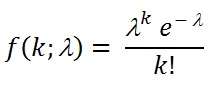
(k=0,1,2,…)

则随机变量X 的分布称为泊松分布,记作P(λ)。这个分布是S.-D.泊松研究二项分布的渐近公式是时提出来的。泊松分布P (λ)中只有一个参数λ ,它既是泊松分布的均值,也是泊松分布的方差。在实际事例中,当一个随机事件,例如某电话交换台收到的呼叫、来到某公共汽车站的乘客、某放射性物质发射出的粒子、显微镜下某区域中的白血球等等,以固定的平均瞬时速率 λ(或称密度)随机且独立地出现时,那么这个事件在单位时间(面积或体积)内出现的次数或个数就近似地服从泊松分布。因此泊松分布在管理科学,运筹学以及自然科学的某些问题中都占有重要的地位。

泊松分布计算器

首页 › 统计 › 泊松分布计算器
最后更新: · 公式与示例已人工校对

泊松分布描述单位时间或空间内稀有事件发生次数。它只有一个参数 λ,既是均值也是方差。当事件以固定平均速率独立随机出现时,计数就近似服从泊松分布,例如一小时内接到的电话数。

使用方法

  1. 填入平均发生次数 λ
  2. 填入关注的次数 k
  3. 点击计算得到恰好 k 次的概率与累积概率

计算公式

概率质量函数 P(X=k) = λ^k · e^(−λ) / k! k 为非负整数
均值与方差 E = λ,Var = λ 两者相等是其特征
与二项分布关系 n 大 p 小时 λ = np 稀有事件近似

计算示例

某客服中心平均每小时接 4 通电话,求一小时内恰好接到 6 通的概率
  1. λ = 4,k = 6
  2. λ^k = 4⁶ = 4096
  3. e^(−4) ≈ 0.0183
  4. 6! = 720
  5. P = 4096 × 0.0183 / 720 ≈ 0.1042,即约 10.4%
结果:约 10.4%

要点与常见误区

常见问题

泊松分布和二项分布怎么区分
二项分布有固定的试验次数上限,成功次数不可能超过 n。泊松分布没有上限,理论上可以无限次,适合描述没有明确试验次数的稀有事件,如某路段一天的事故数。
方差大于均值说明什么
说明数据比泊松分布更分散,称为过度离散。常见于事件存在聚集性,例如传染病例数会因为人际传播而成簇出现。此时应改用负二项分布建模。

相关计算器

查看 全部统计计算器

Poisson Distribution Calculator is an online probability and statistics tool for data analysis programmed to find out the counts of events that occur randomly in a given interval of time. This calculator computes the output values of Poisson and cumulative poisson distribution with respect to the input values of average rate of success and random variables

Definition

The Poisson distribution, a discrete probability function is used estimate the degree of spread with known average rate of occurrence. When situation arise with the experiment where the great number of possible event occurs, the poisson distribution is employed to designate the probability of a given data set or number of events at a fixed time of interval. It is asymmetric function and has the strong connection with hypergeometric, binomial and exponential distributions

where
e is the base of the natural logarithm equal to 2.71828..
k is the number of occurrences of an event; the probability of which is given by the function
k! is the factorial of k
λ is a positive real number, equal to the expected number of occurrences during the given interval. For instance, if the events occur on average 3 times per minute, and one is interested in the probability of an event occurring k times in a 10 minute interval, one would use a Poisson distribution as the model with λ = 10 x 3 = 30